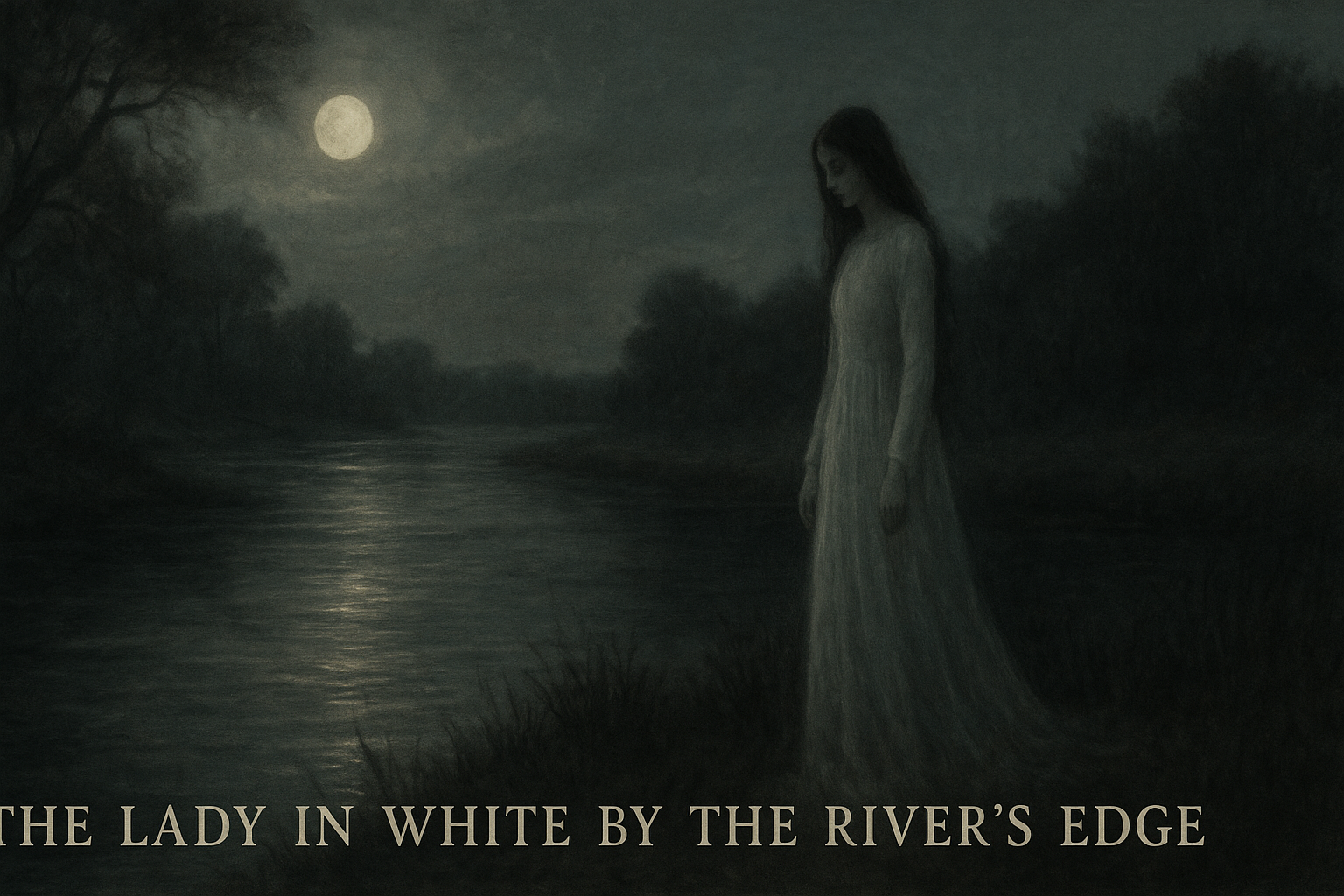
The river is a place of patience. It moves slow and deep, carrying more than silt and fallen branches. It carries memory. Those who have lived along its banks know this. They do not stay after nightfall if they can help it, for they have heard the stories whispered by their grandparents and retold in hushed voices when the wind presses against the shutters.
The story is always the same. On moonlit nights, when the surface of the water looks like hammered silver, she appears, tall, pale, draped in white. Some say it is a wedding dress, others a nightgown, but all agree it clings to her as if she has just stepped from the river itself. Her face is never clear. Witnesses describe her as both beautiful and sorrowful, with eyes that never quite meet yours but seem fixed on something beyond.
It is not uncommon for travelers to mistake her at first for a stranded woman in need of help. More than one has left the safety of the road to follow her down the embankment, certain she is lost. They return, if they return at all, changed. Some cannot speak of what they saw, their words drying up like mud in the sun. Others speak too much, rambling about the coldness of her touch or the sound of rushing water that roared in their ears though the river was calm.
The oldest account comes from a ferryman who rowed people across the river long before the bridge was built. He claimed she would appear near his landing just before dawn, lifting her hand as if to request passage. He never dared bring her aboard, for he noticed that each time she raised her arm, her sleeve was soaked and dripping water. “She had no coin in her hand, no voice came out of her mouth,” he said. “Only that terrible eerie stillness.”
What grief bound her to the river has never been agreed upon. Some say she drowned on her wedding day, cast into the water by a jealous rival. Others tell of a mother who leapt into the current after her lost child, never rising again. There is even a tale that she is not one woman at all but a gathering of many, an embodiment of sorrow, clothed in white, wandering until the river itself forgets their names.
The danger is not merely in seeing her, but in answering her. Those who claim to have spoken to her say she always asks the same question, though in a voice softer than the rustle of reeds: “Will you walk with me?” To agree is to vanish. To refuse is to live, though the refusal leaves a chill that never fades.
There is a bend in the river still avoided by fishermen. They say the air grows heavy there, as if the trees themselves are listening. If you stand on the bank too long, you may hear the sound of footsteps in the grass behind you. Turn quickly, and you will catch the outline of a figure, white against the dark. Step toward her, and she will retreat, always leading you closer to the water’s edge.
It is said that those who fall under her spell are found days later, floating face up in the reeds. Their features show no sign of struggle, only a calm appearance that is unsettling.
Whether she seeks company, revenge, or release, no one has ever discovered. What is certain is this: the river keeps her. And on nights when the moon drapes itself across the current, she rises once more, waiting for another soul to mistake pity for safety, or curiosity for courage.
So if you find yourself by the river at such a time, keep your eyes to the path and your feet to the road. Do not look too long at the silver water, and if you hear the whisper of a woman’s voice asking if you will walk with her—do not answer.
Please do not copy or reproduce these stories, in whole or in part. All works are under copyright by the author. They are shared here solely for your reading enjoyment.



Leave a Reply