Children are warned against games that tamper with the dark. Most grow out of them, leaving behind the chants and dares whispered at sleepovers. But the story of Bloody Mary refuses to fade, passed from one generation to the next like an heirloom no one wants but everyone remembers.
The game is usually simple: a darkened bathroom, a single candle, and a name spoken three times into the glass. The thrill is not in what happens but in what might. Most who play end with nothing more than a nervous laugh. Yet there are accounts that run deeper, accounts that do not stop with a single mirror. They tell of three mirrors, a triangle of reflection, and a ritual that should never be completed.
The first mirror is ordinary. A household looking-glass, hung in a hallway or framed in wood above a sink. By itself, it is harmless, but in the right setting it becomes a threshold. The candle’s flame twists shadows across the face until the reflection is no longer trustworthy. Those who linger too long claim to see subtle changes: their eyes darken, their mouth curls into a smile they never made. Some insist the glass warps slightly, as though under pressure, though no crack appears.
The second mirror alters everything. Placed opposite the first, it creates a corridor of endless reflections. The chain of selves stretches into the distance, each one smaller than the last, as if the soul itself were being pulled farther and farther away. Witnesses describe movement in that corridor, an extra figure stepping into the sequence, growing larger with each blink. Some say she moves like a bride, others like a mourner, her dress clinging damp against her frame. All agree that once she has entered the chain, she does not stop coming forward.
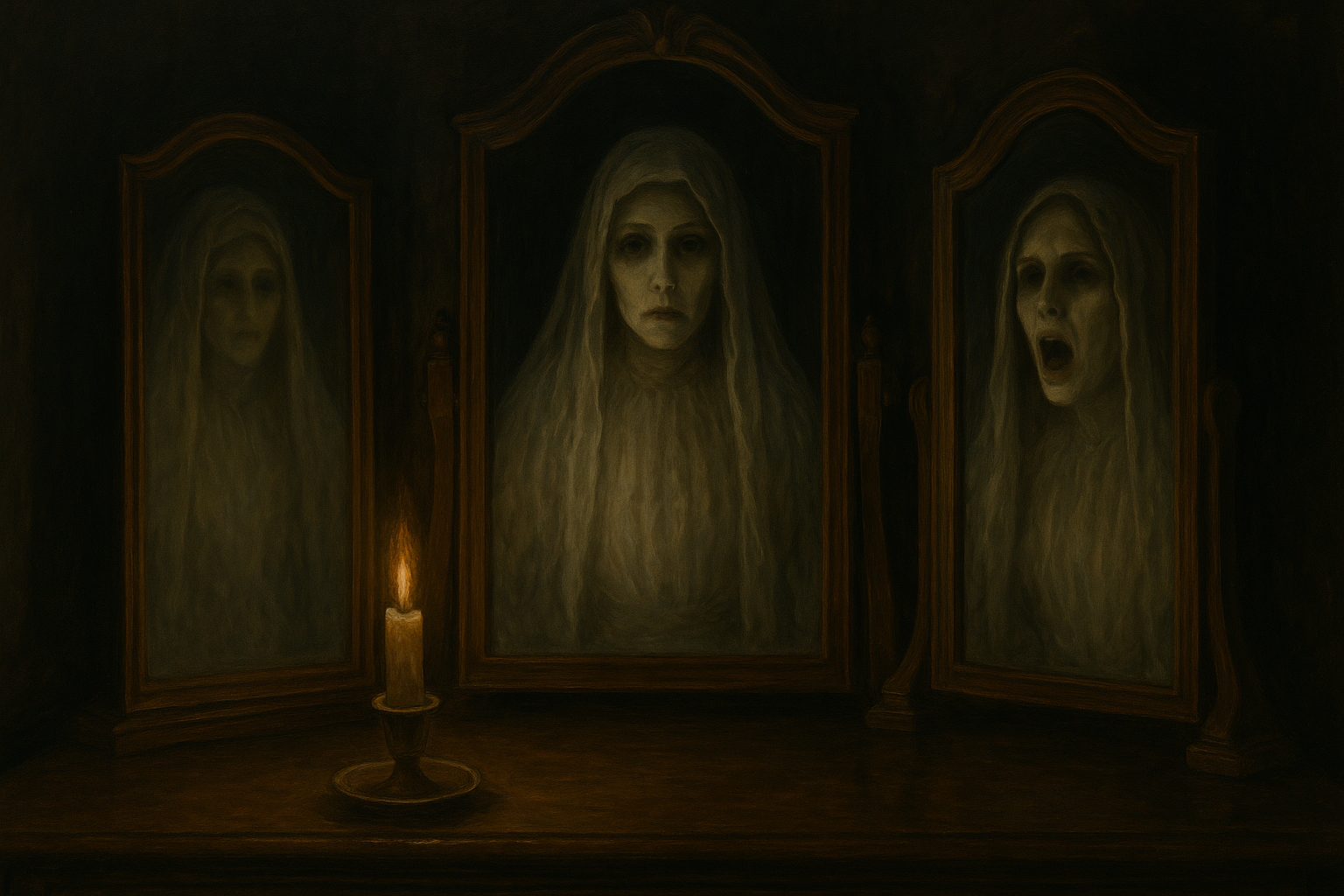
Few dare to add the third mirror. It must be angled carefully to form a crooked triangle, a prison of reflections with the candlelight caught at its center. When the name is spoken then, something changes. Mary does not remain in the depths of the corridor. She steps to the surface.
The three mirrors show her differently. In one, her face is veiled, pale cloth drifting as though underwater. In another, her features are clear but hollow, the sockets of her eyes ringed with shadow. In the third, her mouth gapes open, frozen in the moment before speech. Those who see her like this often break the triangle in panic, shoving a mirror to the floor or smothering the candle. Yet the stories say even that does not always end it. Once she has been called in three reflections, she does not return quietly.
The Midwest town of Bracken Hollow still tells of the girl who vanished on a storm-torn night. She was sixteen, restless, and fond of dares. Her friends dared her to bring three mirrors into her basement during the thunder, to prove once and for all whether the story was only a tale. They waited upstairs. The sound of glass shattering shook the rafters, followed by a cry no one could mistake for laughter. When the parents returned home, they found the friends pale with fear, a candle still burning in the damp cellar. The girl was gone. Not a footprint, not a scrap of cloth. Only the mirrors remained, each fractured in a different way, as though something inside had pressed too hard against the surface.
Older stories reach even farther back. In the nineteenth century, families sometimes covered their mirrors when a loved one died, claiming it kept the spirit from being trapped. Folklorists now suggest this custom may be tied to Mary’s legend, the belief that mirrors could hold more than a reflection. A diary found in Illinois records the account of a widow who swore she saw her dead husband in the second mirror during the ritual, though his face was bloodless and his eyes belonged to someone else.
There are those who claim not all who complete the ritual are taken. Some are left marked. A scar tracing the cheek like splintered glass. A faint cut across the palm that never heals. Or most unsettling of all, eyes that seem to absorb light rather than reflect it. People whisper that such marks are proof Mary tried to pull them through but failed, and that she remembers them. Those who bear the marks learn to avoid antique stores, dressing rooms, or parlors where multiple mirrors stand together. They will not step between reflective surfaces, and they never, ever light a candle in such a place.
The danger, the legends say, is not in speaking her name but in waiting for her answer. For in the third mirror, when her mouth opens, she does not scream. She whispers. The words are always lost to the living, carried into silence with those who vanish. Perhaps she asks a question. Perhaps she makes a promise. Perhaps she gives a command. Whatever it is, no one has ever returned to repeat it.
The warnings are consistent. One mirror unsettles. Two mirrors invite. Three mirrors bind. If you value your reflection, never arrange them so. And if you are ever tempted to stand within their triangle, candle trembling in your hand, remember that the face you see may not remain your own.
Please do not copy or reproduce these stories, in whole or in part. All works are under copyright by the author. They are shared here solely for your reading enjoyment.



Leave a Reply