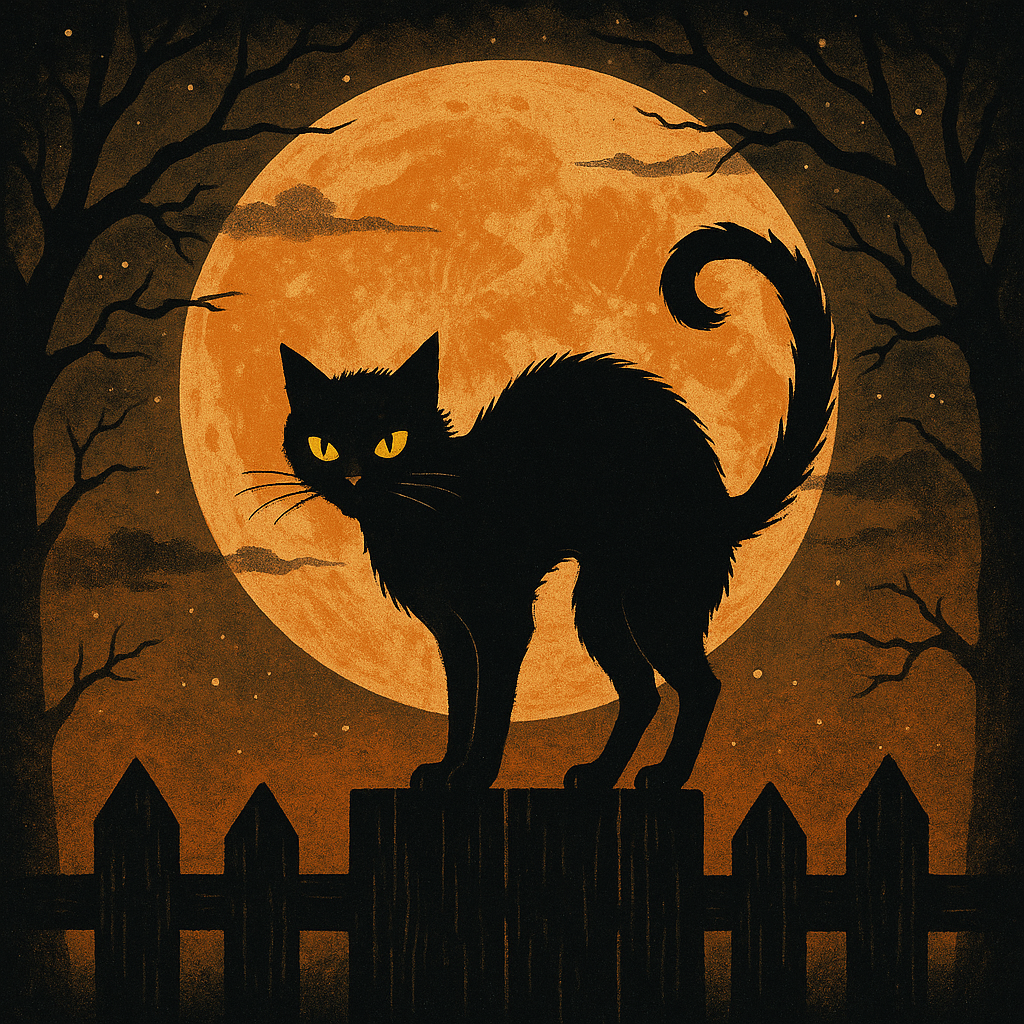
Every October, as pumpkins glow on porches and the air sharpens with that unmistakable shift toward autumn, one image takes its place among the witches, skeletons, and haunted houses: the black cat. Perched on a fence post with glowing eyes, arched back, and tail like a question mark, the black cat has become a shorthand symbol of Halloween itself.
But why?
What power does this animal still hold in our imagination?
The answer is more layered than we might expect, rooted in centuries of folklore, fear, and fascination.
A Creature in the Shadows
Black cats live in plain sight, yet we rarely see them as just cats. Other cats might lounge in windowsills or curl on couches, but a black cat slipping across a street at night transforms the ordinary into something else. A shape. A shadow. A question.
Our reaction is not entirely logical. A black coat is nothing unusual in the animal world. Crows, bears, panthers, even dogs all wear black, and we don’t attach to them the same aura of superstition. Something about the small, silent, independent cat, especially one whose fur erases it into the dark has always unsettled people. It suggests secrets, or maybe the unseen world walking too close to our own.
The Witch’s Familiar
The tie between black cats and Halloween cannot be untangled from the image of the witch. In medieval Europe, when suspicion of witchcraft was at its height, cats were believed to serve witches as their “familiars.” A familiar was not just a pet, it was a spirit helper, an accomplice in magic, even a demon in disguise.
Black cats were especially accused of this role because their color aligned them with night, secrecy, and the devil himself. Stories spread of witches transforming into cats to slip through keyholes or prowl unseen. A cat lingering outside your door at dusk might not be a cat at all, but your neighbor in another shape, keeping watch.
Halloween, which grew out of Samhain, an ancient festival marking the thinning veil between worlds, offered the perfect stage for this idea. If spirits walked freely on October nights, then surely a witch and her cat were moving among them.
Luck, Good and Bad
The black cat’s reputation didn’t stop at witchcraft. Across time and culture, it has swung between bringing misfortune and bestowing blessings. In much of Europe, to cross paths with a black cat was bad luck. Sailors, however, often carried black cats on ships as charms for safe voyages. In Japan and Scotland, a black cat on your doorstep could signal prosperity.
This duality only deepens the Halloween connection. Halloween thrives on tension, the thrill of being scared without real danger, the mingling of fun and fear. The black cat embodies that perfectly. Is it a curse or a blessing? A demon or a guardian? We never quite know, and that’s why the symbol endures.
The American Picture
When Halloween traditions crossed into America, the black cat came along for the ride. By the early 20th century, postcards, party decorations, and advertisements began cementing the cat’s role in Halloween iconography. Artists gave it glowing eyes, jagged fur, and exaggerated poses. Sometimes it appeared alongside witches; other times it stood alone, as if it itself were the haunting presence.
These images weren’t random, they drew on centuries of fear but also on the simple fact that black cats look right in October. Against pumpkins, against bonfires, against twilight skies, they pop like living silhouettes. No other animal blends so well with the Halloween palette of orange and black.
The Real Black Cat
Behind the symbol, of course, is the real animal. Black cats are just cats, playful, moody, affectionate, or aloof like any of their kin. But because of the superstitions tied to them, they’ve often suffered. Even today, animal shelters report difficulty adopting out black cats. Some hesitate to place them around Halloween for fear of pranks or worse.
There’s an irony here. The very thing that makes the black cat so striking in folklore the way it vanishes into shadow, also makes it harder for people to connect with in real life. Photographs don’t capture them as easily. In shelters, their features can blur, while lighter-colored cats seem more approachable.
Yet ask anyone who has lived with a black cat, and they’ll tell you the opposite: these cats can be charming, quirky, loyal companions. If Halloween casts them as mysterious figures, perhaps the truth is simply that they are blank slates, waiting for us to project onto them what we most fear or what we most need.
A Symbol That Endures
Why, of all the possible creatures, does the black cat hold on so tightly to Halloween? Because it’s more than a leftover superstition. It’s a mirror.
We see in the black cat our unease with the unknown. A path crossed at night. A flash of eyes in the dark. A creature that moves silently where we cannot. It reminds us that the world is not fully ours to explain or control. On Halloween, when we embrace mystery and lean into shadows, the black cat is the perfect companion.
It doesn’t belong to the same category as pumpkins, candy, or costumes. Those are trappings. The black cat is closer to the bone of what Halloween means: that flicker of wonder and fear when we recognize the limits of what we know.
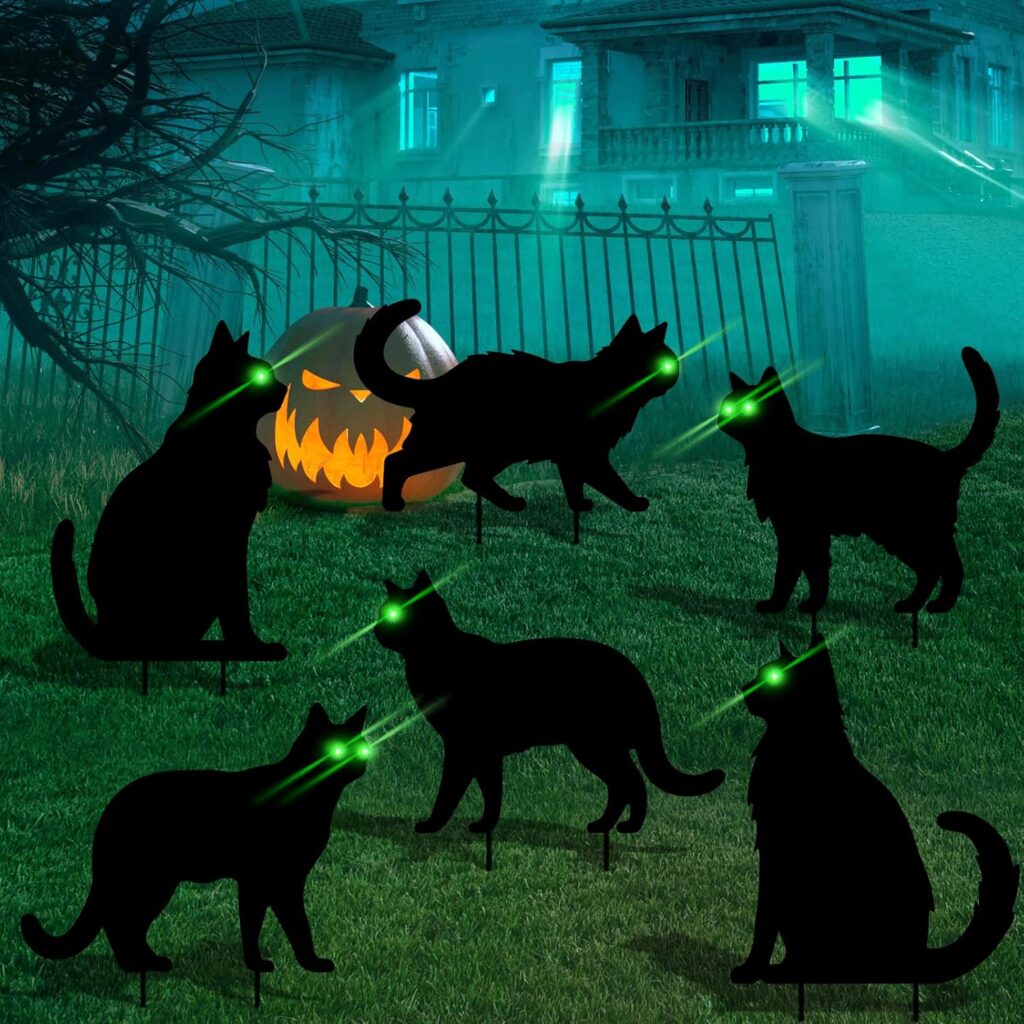
6 Pcs Black Cat Halloween Decorations Plastic Yard Signs with Stakes,Halloween Decorations Outdoor, Scary Silhouette with Glow in Dark Eyes for Outdoor Yard Lawn Garden Halloween Décor
The Black Cat Returns
Every Halloween, the black cat returns to us on decorations, in stories, and sometimes, if we’re lucky, padding across our yards in real life. It comes not as a curse, nor as a blessing, but as a reminder. That shadows have depth. That night holds secrets. That not everything must be explained away.
The black cat of Halloween is more than an emblem. It is the lingering figure at the edge of the porch light, the shape you can’t quite name, the old superstition you can’t fully shake. It is the question mark curled into the October night.
So when you see that arched silhouette this Halloween, pause before brushing it off as just another decoration. Consider how many centuries it has walked with us through fear, folklore, and festivity. Think of the sailors who trusted it, the witches who were accused with it, the children who drew it on postcards a century ago, and the real cats waiting in shelters now.
The black cat does not need us to solve it. Its mystery is its power. And on Halloween night, as doorbells ring and jack-o’-lanterns glow, we may feel that familiar shiver when a dark shape crosses the street.
Some part of us still wonders: was it only a cat?



Leave a Reply