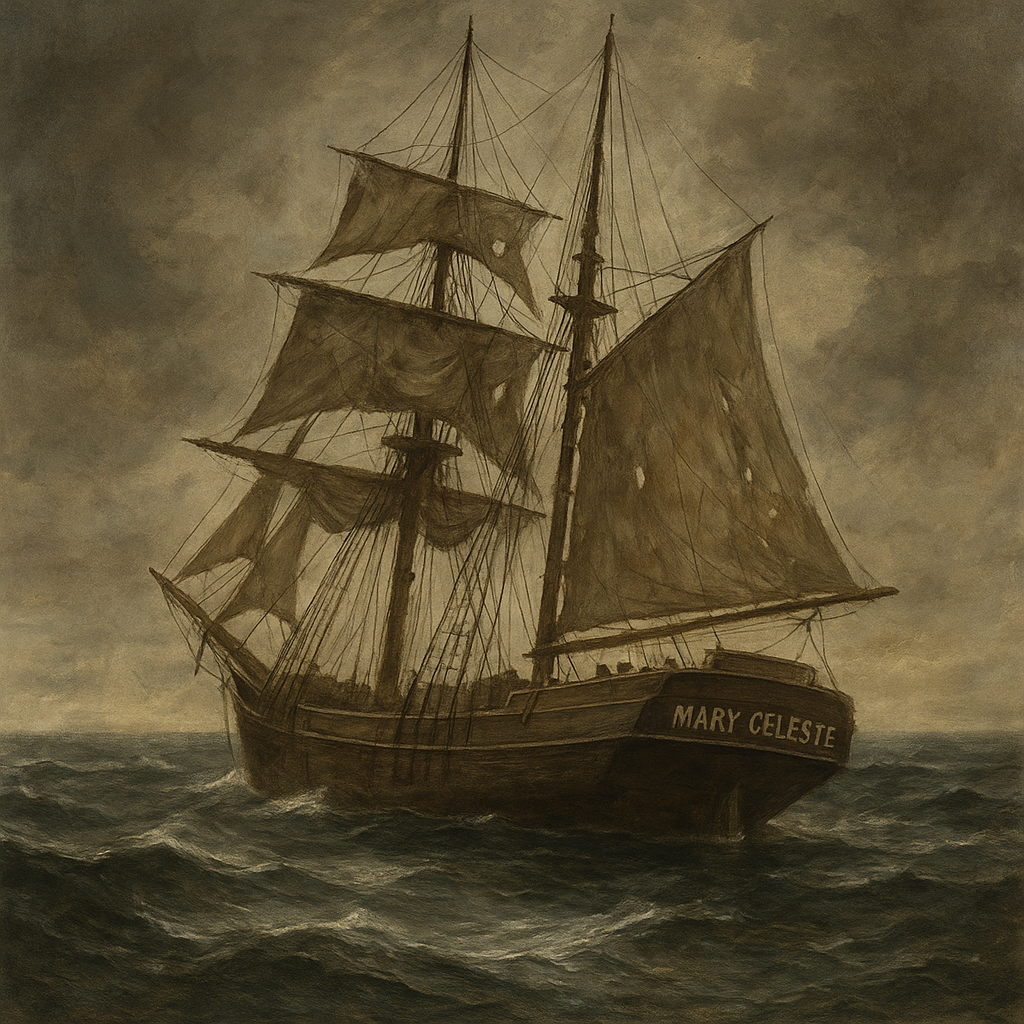
On December 4, 1872, the crew of the Dei Gratia spotted a vessel drifting aimlessly in the North Atlantic. Its sails flapped in the cold wind, half-torn, yet the ship itself showed no sign of sinking. She rode the waves like a ghost, abandoned and forlorn.
The ship’s name was painted clearly on her stern: Mary Celeste.
When the boarding party climbed aboard, they expected a gruesome scene—a battle, perhaps, or bodies. But the decks were eerily silent. The lifeboat was gone. The captain’s logbook stopped abruptly ten days earlier. The cabins were neat, as if their occupants had only just stepped out. The captain’s pipe still lay on the table. Half-eaten meals had long since spoiled. Provisions for six months sat untouched in the hold.
And yet, the people were gone.
Captain Benjamin Briggs, his wife, their two-year-old daughter, and seven experienced sailors had vanished into thin air. No blood, no struggle, no sign of panic—only an empty ship, left adrift in the vast ocean.
Theories swirled quickly. Some whispered of pirates, though nothing had been stolen. Others imagined mutiny, but the evidence was missing. A more chilling thought was that the cargo itself—barrels of raw alcohol—may have leaked, filling the air with invisible fumes. Perhaps the crew, fearing explosion, fled into the lifeboat, never to be seen again.
But none of these theories satisfy the deep unease that clings to the tale. For how could seasoned sailors abandon a sturdy ship, one still seaworthy and full of food, in the middle of the ocean?
In the years since, the Mary Celeste has sailed into legend as a ghost ship, a reminder that the sea keeps its secrets well. Sailors still tell the story on stormy nights, when the wind howls through the rigging and the waves strike hard against the hull.
Some say if you listen closely, you can hear the faint creak of her timbers on the dark water, searching endlessly for a crew that will never return.
Happy Halloween—some mysteries are scarier because they’re true.



Leave a Reply