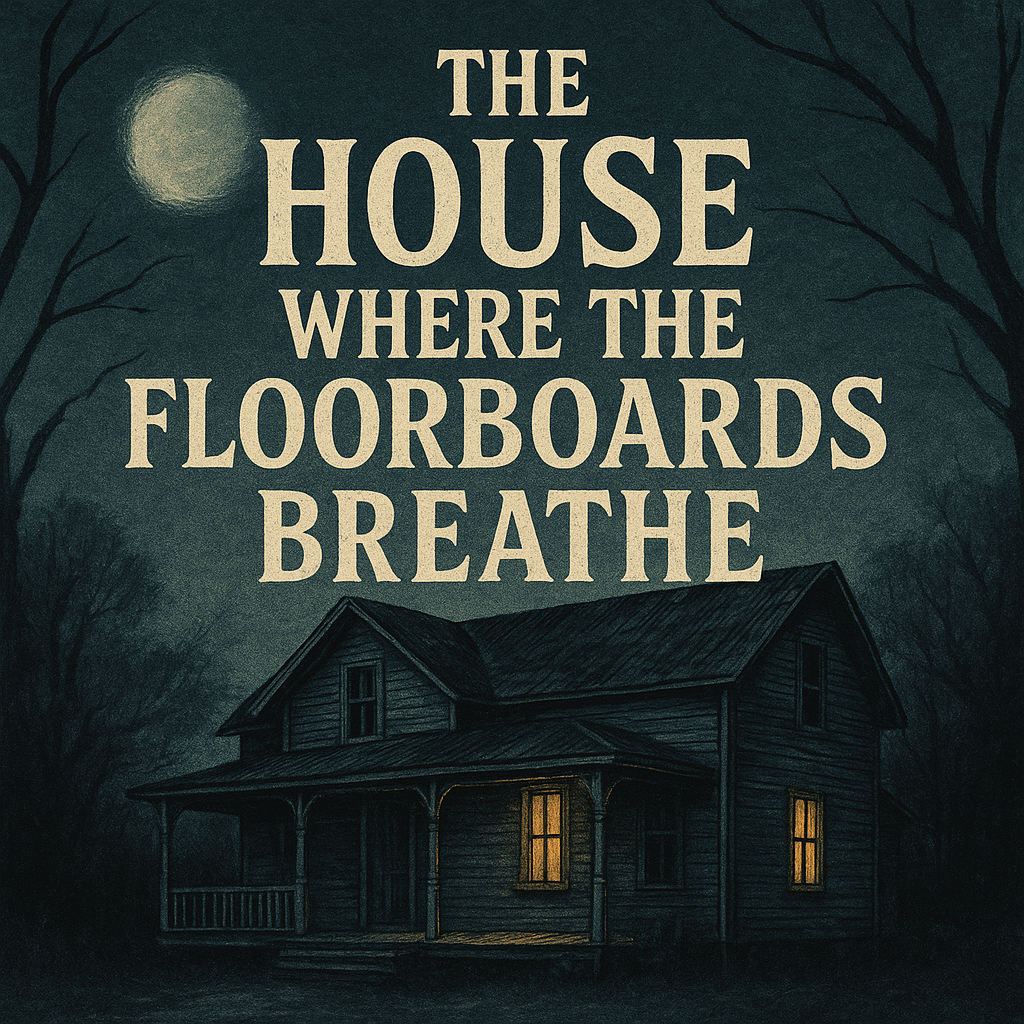
The old house sat at the end of a narrow dirt road, its porch sagging just enough to show its years, yet proud in its own stubborn way. The cypress boards that framed it had silvered with time, and the windows, once crisp and clear, now held the faint blur of old glass like cataracts in the eyes of something still alive. People said no one lived there, though there was always a light on in one room. Sometimes it flickered at odd hours, as if the house itself forgot it was supposed to be empty.
I first saw it when I was sixteen, walking home after dusk from a fishing hole I wasn’t supposed to be near. A summer storm had just passed, and the air was thick and wet, smelling of pine and lightning. When I stopped to rest by the gate, I heard what sounded like the house breathing. It was faint but steady, a low rise and fall, like someone sighing beneath the floorboards.
That night, I told my grandfather about it. He leaned back in his chair and stared at the dark line of the woods. “That place,” he said, “was built by the Wetherby family. They ran a sawmill out here before the war. Had a daughter, Clara. Pretty thing, always wore yellow. They say she used to hum while she swept the porch. One summer she got sick. Never got better. Her folks buried her on the hill behind the house.” He paused. “After that, the boards started to move.”
I didn’t go back for years. But the memory of that breathing never left me. Sometimes, lying in bed at night, I could almost hear it again, the slow inhale of the earth itself. It wasn’t until much later, after my grandfather passed, that I returned. The house hadn’t fallen, though it leaned more than I remembered. The door gave way when I pushed, and the scent of damp wood and dust rolled out, as if the place had been waiting to exhale.
Inside, sunlight filtered through slats and holes, cutting the air into pale ribbons. I stepped carefully across the warped boards, and each one creaked beneath me. At first, I thought it was just the sound of age. Then I realized it wasn’t just creaking. The floor was shifting, subtly lifting under my feet, as though it had lungs.
I stood still, listening. The boards swelled, then settled again. A rhythm, faint but alive. I knelt and pressed my palm flat against the floor. The warmth startled me. Something moved beneath the wood, slow and patient, like water under ice.
The room to my left still had furniture, an old rocking chair, a mirror hanging crooked on the wall. When I caught my reflection, I saw movement behind me. Just a ripple in the air, like heat shimmer, but it drew me toward the far corner. There, a patch of floorboards was darker than the rest. I crouched again, running my hand along the seam. The wood pulsed once, almost gently. Then it went still.
Outside, the wind stirred the trees. Somewhere, a whippoorwill called. The house seemed to listen with me. Then, softly, the boards lifted again, exhaling a sigh that wasn’t quite human.
I stood and whispered, “Clara?”
The air thickened, and from the dark seam between the boards came the faintest hum, almost a melody. It was a girl’s voice, quiet and careful, as though it had been waiting all these years for someone to answer.
I don’t remember leaving the house, only the sound that followed me down the road—a slow, even breath behind every step. Sometimes I still hear it when the nights are heavy and wet with rain. It isn’t frightening anymore. It feels more like memory than haunting, a heartbeat left behind in the wood, still trying to keep time.
And when I pass that old place on my way to the river, I always pause.
I listen.
And I swear the house still breathes.


Leave a Reply