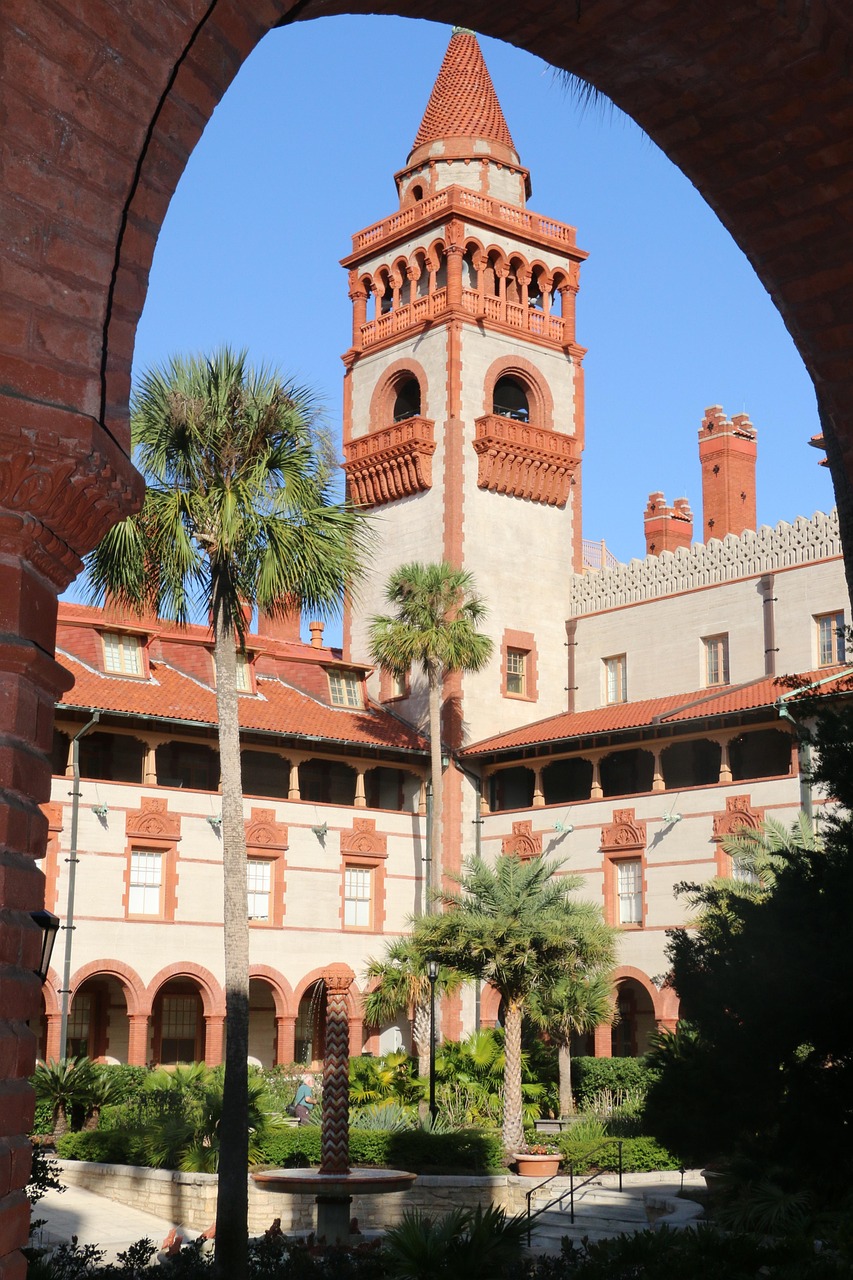
The towers of Flagler College in St. Augustine, Florida, rise like a memory of another century, its red-tiled roofs and carved stone details, secrets of a time when tycoons built palaces for leisure and the wealthy flocked south for winter.
Though students now pass through these grand archways with backpacks and coffee cups, the old hotel still breathes beneath the college walls. And some say, not all who check in ever really leave.
Flagler College was once the Ponce de León Hotel, the crown jewel in Henry Flagler’s Gilded Age vision of turning St. Augustine into a resort city for America’s elite. Opened in 1888, it boasted lavish furnishings, hand-painted murals, and the opulent touch of Louis Comfort Tiffany’s stained glass. It was a marvel, both in architecture and in excess. But like so many buildings with such deep roots, its past is not entirely quiet. Within its halls, particularly on the upper floors and near the great rotunda–there are stories.
Stories of women. Three of them.
They are not named in the college brochures. You won’t see them in the orientation packet. But ask around quietly, and you’ll hear of them, the three spectral ladies of Flagler College.
The first is the most tragic, the most visible, and perhaps the most sympathetic. She is said to be the ghost of Ida Alice, the second wife of Henry Flagler. Once a socialite and lively companion, Ida’s mental health began to deteriorate shortly after their marriage. She was eventually declared insane and confined to a sanatorium, while Henry continued to build his empire without her. Yet something of her remained here.
Students and visitors have reported seeing a pale woman in period dress standing silently before the large portrait of Henry Flagler that hangs in the grand hall. She doesn’t speak. She doesn’t move. She simply stares, her expression unreadable, some say sorrowful, others say filled with accusation. When approached, she vanishes, some say she’s waiting for forgiveness, others believe she’s mourning what was taken from her.
The second woman is more unsettling. Known simply as “the woman in black,” she is a specter wrapped in mystery and rumor. According to whispered tales passed through generations of students, she may have been one of Flagler’s mistresses, an actress, perhaps, or a singer. It’s said she was kept hidden on the fourth floor, in a room lined with mirrors–a psychomanteum, a space used for spiritual reflection and contacting the dead. Whether she lost her mind from loneliness, madness, or something far stranger, no one can say. But her end was not peaceful. The story claims she hanged herself from a chandelier, and her presence never truly left.
The fourth floor, now used for storage or kept locked, is often avoided. Those who’ve wandered too close have heard soft weeping, or a sudden clang of metal from behind locked doors. Some have seen her: a dark figure drifting across the hallway, eyes black as pitch, a long Victorian gown brushing the floor. She appears most often when someone is alone–when the silence feels too heavy, when the shadows begin to stretch.
The third lady is less known, yet no less present. No name clings to her, no portrait confirms her identity. She is, in many ways, a whisper of a ghost–seen only in brief glimpses. A woman in old-fashioned clothing descending the staircase when no one else is around. A cold gust sweeping through the hall despite sealed windows. A flicker in the mirror when one looks too long. She is believed to be a guest from the hotel’s earliest years, one who perhaps never meant to stay so long. If the other two spirits are tethered by pain or betrayal, this one seems drawn simply by memory–the echo of a place she once loved, a space she isn’t ready
to relinquish.
What makes these tales linger isn’t just the drama or the sorrow, they persist because people keep seeing them. Students who swear they turned around to find no one following them, despite hearing clear footsteps. Faculty who have locked doors behind them only to find them ajar minutes later. Tourists who feel a sudden chill pass through the rotunda or see a shadow in a Tiffany window that shouldn’t be there.
Flagler College stands today not only as a monument to Henry Flagler’s ambition but as a living testament to the layers of time that inhabit every brick and beam. History doesn’t sleep here. It walks the halls in high-buttoned boots and silk gloves, gazing at portraits, trailing cold fingers along polished banisters.
And when the night deepens, and the wind moves through the palms outside, some say you can still hear them, the three women, each bound by her own reason, each unwilling to fully leave the grand hotel behind.



Leave a Reply